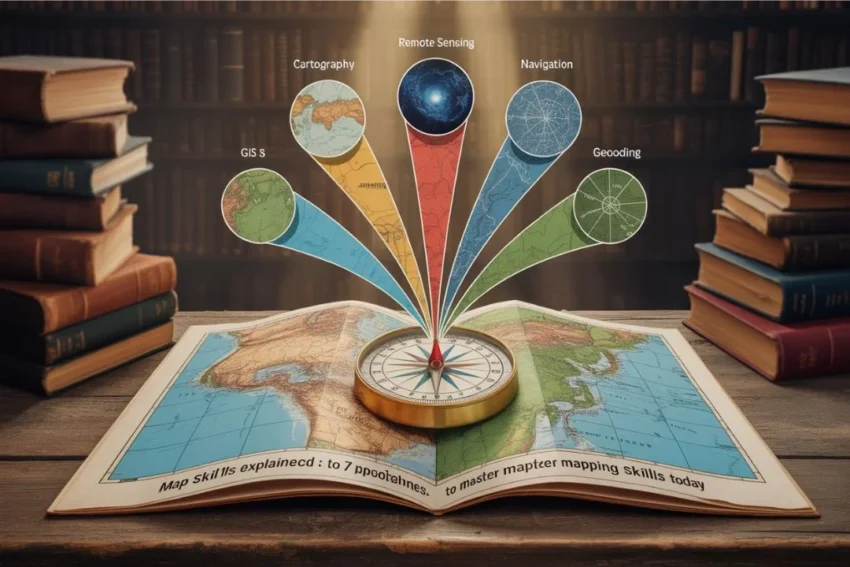
Introduction:
Map skills are a very important skill in our daily lives and in the field of education. This skill gives us the ability to read, understand and use different types of maps. There are millions of maps in the world.Which show various features of the earth, cities, rivers, mountains and other geographical information. Through Map skills, we can improve our lives and work by understanding this information correctly.
In this article, we will explain all aspects of map skills in detail, so that you can become an expert in mapping skills.
What are Map Skills?
Mapping skills or map skills refer to the abilities and techniques that help us read various maps, interpret the symbols and signs on them, and understand real-world places and information.
This skill empowers us to obtain geographic information about any location with the help of map directions, scales, symbols, and other elements.
The importance of mapping skills
Educational importance
Map skills are essential for students in education. Understanding maps in subjects such as geography, history, and environment not only makes information easier to understand but also increases the ability to analyze. Students can score higher in exams with better mapping skills.
Importance in practical life
Mapping skills are also important in everyday life. Whether you’re traveling, responding to natural disasters, or exploring a new place, map skills are a source of guidance and safety.
Basic types of mapping skills
Recognizing directions
Recognizing directions is the most basic skill in map reading. It is not possible to properly understand a map without recognizing North, South, East, and West. Similarly, knowing the intermediate directions such as Northeast, Southwest, etc. is also important.
Understanding Scale
Distance on a map is represented by scale. Scale tells us how much distance a given unit on a map represents in the real world. This skill helps us convert information on a map into real distance.
Identifying Symbols
Maps use various symbols to show specific features such as rivers, mountains, roads, cities, forests, and other geographical elements. Understanding and remembering these symbols is an important part of map skills.
Reading Legend
Legion explains the symbols used on the map. It is very important to understand Legion so that the meaning of each symbol on the map is clear.
Height and Depth Measurement (Contours)
Some maps show the height or depth of the land surface using contour lines. This skill is especially important for mapping and analyzing mountainous areas.
Practical uses of mapping skills
Education
Students in educational institutions use map skills for various subjects such as geography, history, and science to better understand and analyze.
Environment and Science
Ecologists, geographers, and scientists use mapping skills to monitor land changes, protect natural resources, and monitor disasters.
Military and Defense
The use of maps is extremely important in military operations. Military commanders rely on map skills to plan their strategies and determine the location of the enemy.
Tourism Industry
Tourists and travelers use map skills to reach their destinations and find their way so that their journey is easy and safe.
How to improve mapping skills?
Practical exercises
See different types of maps in everyday life and try to understand them. Make maps of local areas or create maps of the area around school and home.
Get help from educational materials
Improve map skills with books, videos, and online courses.
Use modern technology
GPS, Google Maps, and other digital maps are also helpful in developing mapping skills
Benefits of mapping skills
- Your knowledge of the world increases.
- Decision-making and problem-solving skills improve.
- Academic performance improves.
- Tourism and travel are facilitated.
- Aids in rescue and relief operations during natural disasters.
Top 5 Related Keywords for “Map Skills”
- Map Reading Skills
- Principles of Map Making
- Learning Map Making for Kids
- Map Skills in Geography
- Recognizing Map Symbols and Directions
5 benefits of map skills:
Increasing geographical understanding:
Reading a map can help you better understand the countries, cities, natural resources, and regions of the world.
Accurate recognition of directions and distances:
Learning map skills helps a person accurately assess their direction and location in the real world, especially during travel or research.
Improvement in academic performance:
Students achieve better results in geography, history, and environmental subjects because they can understand maps effectively.
Decision-making assistance:
Maps can be used to assess the structure of the terrain, routes, and natural obstacles to make better decisions, such as urban planning or defense strategies.
Increasing digital skills:
Modern map skills, such as using Google Maps or GIS software, are becoming essential for success in the digital world.
5 Disadvantages of Map Skills:
Fear of misinformation:
If the information on the map is outdated or not updated, it can lead to incorrect decisions or route selection.
Over-reliance on technical resources:
Over-reliance on GPS or apps for digital map skills can lead to a loss of self-confidence.
Misunderstanding of symptoms or scale:
If the symbols or scale are not understood, the map can be misinterpreted.
Difficult terms and technical language:
Mapping language (such as contours, grid references, etc.) can be difficult for beginning learners.
Difficult for those with limited visual understanding:
Reading maps can be a challenge for people with visual impairments or poor eyesight.
Frequently Asked Questions (FAQs) related to Map Skills
What are Map Skills?
Mapping skills are the abilities through which we learn to read, understand, and use maps. This includes determining directions, identifying symbols, understanding scale, and analyzing information.
What are the basic things to learn to read a map?
Understanding directions (north, south, east, west), scale, symbols, legend, and contour lines are basic skills for reading a map.
Which people use mapping skills the most?
Soldiers, geographers, students, scientists, environmentalists, and tourists use mapping skills extensively in their daily work.
Are Map Skills only necessary for students?
No, this skill is useful for everyone. Travelers, rescue teams, drivers, and urban planners all need mapping skills.
What is the best way to teach Map Skills to children?
Picture maps, games, and hands-on activities like making a map of their school or home are great ways to teach children Map Skills. This will also increase their interest in learning.
Have digital maps (Google Maps, etc.) diminished the importance of traditional map skills?
No, digital maps are certainly a convenient convenience, but traditional mapping skills are still important because they promote geographic understanding, analytical thinking, and self-reliance.
(Conclusion)
Map skills are a fundamental and very useful skill that not only opens the door to success in the academic field but also provides countless opportunities in practical life. Whether you are a student, a tourist, an environmentalist or a common person, the ability to read and understand a map helps you to better understand the world, recognize directions and make correct decisions.
In today’s digital age, with conveniences like GPS and Google Maps, basic map skills are still as important as ever. These skills not only build self-confidence, but also foster analytical thinking, geographic understanding, and self-reliance.
Therefore, every individual should learn the skill of mapping and make it a part of their life, so that the world can be better understood and every path, every decision, can be taken with confidence.