
(Introduction)
Every child begins a critical phase of physical, mental, social, and emotional development when they reach the age of three to four. Fine motor skills activities for 3-4 year olds are especially important during this time because these skills strengthen the ability to learn later, write, feed themselves, dress themselves, and perform daily tasks.
Fine motor movements are movements that use the small muscles of the hands, fingers, wrists, and sometimes arms. Such as picking up small objects, working with clay tabletops, coloring, and cutting.
In this article, we will learn what fine motor skills activities for 3‑4 year olds are, why they are important, which activities are effective, how to implement them at home or school, what the role of parents and teachers should be, and some safety tips.
What are fine motor skills?
Fine motor skills are movements that use small muscles, especially those in the hands, fingers, and wrists. These movements are usually deliberate and careful, such as:
- Grasping with fingers
- Pinching or pinching between the thumb and forefinger
- Grasping and releasing small objects
- Holding a pen to write or color
- Scraping and cutting
Fine motor skills activities for 3‑4 year olds — why are they important?
- Educational readiness: Fine motor skills are fundamental to learning to write, color, and write. If these skills are strong, it will be easier for a child to write letters and draw shapes.
- Independence and confidence: When children can feed themselves, dress themselves, and open doors, they gain a sense of confidence.
- Brain development: Fine motor movements increase the connection between the brain and the hand; neural connections are strengthened.
- Physical balance: The muscles of the wrist, fingers, and hand are strengthened, improving hand control, which is helpful later in sports and other activities.
- Social and emotional development: Participating in group activities, working with others, and feeling the joy of completing tasks enhances a child’s personality.
How to do fine motor skills activities for 3-4 year olds at home
Weekly planning
- Include daily routines: for example, coloring, playing with stickers.
- Allocate daily time: At least 15-20 minutes a day to activities where children do something with their hands.
- Take advantage of the weather and environment: for example, indoors on snowy nights, in the garden or in the fields on warm days.
Selection of resources and materials
- Use materials that are appropriate and safe for children. Avoid toxic colors or small pieces that can be swallowed.
- Use thick and sturdy tools such as thick pencils, safe scissors.
- Use colorful and interesting objects to keep children curious.
Style and guidance
- Model the activity for the child when starting: do it yourself.
- Give positive reinforcement; say things like “great”, “great effort”.
- Give the child time to try on their own, with minimal intervention but don’t neglect safety aspects.
Strategies for fine motor skills activities for 3‑4 year olds in educational institutions and schools
- Thematic projects: Organize activities around a specific theme, such as a “garden” theme using leaves, flowers, etc.
- Integration: Combine with other subjects – e.g., adding stickers to a story, or building blocks in math.institutions and schools
- ‘Group work: Let children work in groups, such as building a large puzzle, a shared structure from blocks.
The role of parents and guardians
- Encouragement and praise: Appreciate every small success the child makes.
- Patience: Some children will take time to complete an activity.
- Providing the environment: Space in the home, safe materials, quiet time — all of these are important.
- Observation: If there is a problem, such as a finger grip not changing or the hand feeling tired, it is useful to consult a therapist.
There should be no small pieces that could be choked or swallowed.
- There should be no small pieces that could be choked or swallowed.
- The colors and materials should be non-toxic and safe for children.
- Scissors or other sharp tools should always be used under supervision.
- All activities should be in a location with adequate lighting and non-slip floors.
Monitoring the development of fine motor skills
- Daily observation: See if the child feels comfortable coloring, using scissors, writing, and holding things.
- Documentation of progress: Keep photos, videos, or activity records to see changes.
- Feedback: Ask the child what activities they enjoy and what they find difficult.
- Professional advice: If a child’s fine motor skills are significantly less than other children, consultation with a pediatrician, therapist, or medical professional is necessary.
Why are Fine Motor Skills important?
Academic preparation
When a child is required to write, color, or draw shapes in preschool or nursery, the role of their fine motor skills becomes prominent.
Self-confidence
When a child can dress themselves or feed themselves, they learn to trust themselves, and this self-confidence comes in handy throughout their lives.
Brain development
These skills improve the connection between the brain and the hand at a neurological level, which is essential for brain development.
List of Fine Motor Skills Activities for 3-4 Year Olds
Here we are providing you with a list of more than 25 effective, interesting, and safe activities for children that strengthen the fine motor skills of 3 to 4 year olds.
Coloring
- Provide thick pencils or crayons
- Give simple shapes like apple, star, sun
- Also teach color recognition
Painting
- Finger painting
- Teach how to use a brush
- Watercolors are best
Playing with blocks
- Give LEGO or large blocks
- Ask to make shapes
- Allow to break and rebuild
Sticking stickers
- Give different stickers
- Ask to stick them in a specific place
- Hand control will be better
How to do Fine Motor Skills Activities at Home?
Easy Ways:
- Take just 20 minutes a day
- Make activities into games
- Give praise, don’t discourage failure
Things to have at home:
- Old clothes
- Paper, pencil, scissors
- Colorful plastic beads
- Play-Doh, brushes, stickers
The role of parents
- Praise your child’s effort
- If your child is afraid to do an activity, try it yourself
- Find out what activities they like
- Don’t force them, or they’ll lose interest
Safeguards
- Scissors should only be used under supervision
- Beads or small objects pose a choking hazard
- Colors, paints, and clay should be non-toxic
- Maintain a clean environment
How to assess children’s development?

- Does the child hold a pen correctly?
- Can he press small buttons?
- Can he complete puzzles?
- Does he have difficulty feeding himself?
If there is a delay in the above, it is advisable to consult a pediatrician or a pediatrician.
Benefits: (Questions & Answers – Fine Motor Skills Activities for 3-4 Year Olds)
How do fine motor skills activities help children’s academic performance?
These activities teach children the ability to hold a pen, write, and write on a line, which helps them perform well in preschool and enable them to learn quickly.
Do these activities increase self-esteem?
Yes, when a child buttons a button, puts on clothes, or colors a picture by themselves, they feel a sense of accomplishment that increases self-confidence.
What role do these activities play in brain development?
These activities create a connection between the hand and the brain, which stimulates neurons and improves brain development.
Do they promote children’s creativity?
Of course, activities like coloring, making shapes with clay, and sticking stickers enhance children’s creative thinking and imagination.
Do children become independent through these activities?
Yes, when children eat from a spoon or dress themselves, they are able to do daily tasks on their own, which builds self-reliance.
How do fine motor activities help children’s physical balance?
These activities strengthen the small muscles of the wrist, fingers, and arm, which improves the child’s hand control and physical balance.
What impact do these activities have on children’s social skills?
When children build something with blocks in a group or solve puzzles together, they learn to share, be patient, and communicate with others.
Do these activities make children’s daily lives easier?
Yes, these activities enable children to button, zip, and do small tasks on their own, which makes their lives easier.
Disadvantages: (Questions & Answers – If Fine Motor Skills Activities Are Ignored)
What effect could it have on a child’s writing if these activities are not done?
Such children cannot hold a pencil or pen properly, their handwriting is scattered, and they lag behind in written tasks.
Can the absence of these activities reduce self-esteem?
Yes, when children can’t do small tasks like buttoning or coloring, they feel weak, which affects self-esteem.
Can this hinder children’s educational progress?
Of course, when children don’t learn fine motor skills, they lose interest in preschool or nursery activities and fall behind.
Is hand-eye coordination affected?
Yes, if children do not do these activities, their hand-eye coordination remains weak, making it difficult for them to handle objects.
How does not learning this skill affect daily tasks?
Such children cannot dress themselves, ask for help with eating, and are dependent even for small tasks.
Can brain development be affected?
Yes, fine motor skills strengthen brain connections, without them a child’s mind can become somewhat sluggish.
Can there also be a disorder in physical balance?
If the muscles in the fingers and wrists remain weak, children drop objects or have difficulty holding them, which impairs balance.
Can it limit children’s creativity?
Yes, without creative activities, a child’s mind becomes closed, he lags behind in thinking and creating new things.
FAQs: Fine Motor Skills Activities for 3-4 Year Olds
What are fine motor skills activities for 3-4 year olds?
Fine motor skills activities are activities designed to improve the movement of the small muscles in children’s hands, fingers, and wrists. At ages 3 to 4, children begin to refine their fine motor skills, such as grasping objects, practicing writing, buttoning, and using eating utensils.These activities give children the ability to perform small and complex tasks that are crucial for their daily lives and educational development.
What fine motor skills activities are best for 3 to 4 year olds?
The best fine motor skills activities for 3- to 4-year-olds include coloring, making shapes with Play-Doh or clay, cutting paper with scissors, building with blocks, sticking stickers, beading, zipping, and buttoning. These activities strengthen children’s finger and hand grip and also enhance their creativity.
Do these activities help children’s academic development?
Yes, fine motor skills activities prepare children for writing, reading, and other academic tasks in the classroom. When children learn to use small hand movements better, their academic performance also improves as they can more easily hold a pen, turn the pages of a book, and handle other educational materials.
How can parents provide fine motor skills activities for children?
Parents can easily organize various activities for children at home, such as coloring, cutting out paper, sticking stickers, and playing with clay. Parents should take into account children’s interests and present the activities in a playful way so that children can participate happily and learn these skills in a natural way.
What should be done if children are weak in fine motor skills activities?
If a child is lacking in fine motor skills, immediate advice should be sought from a pediatrician, therapist, or pediatrician. In addition, special attention should be paid to enhancing fine motor activities at home and activities should be progressed from easy to difficult so that the child feels at ease and feels confident.
Are fine motor skills limited to hand movements?
No, fine motor skills involve small movements of the hands and fingers, but these skills also improve hand-eye coordination. This means that when a child sees and moves their hands, different parts of the brain work together, which is essential for brain development.
Should schools include a section on fine motor skills activities?
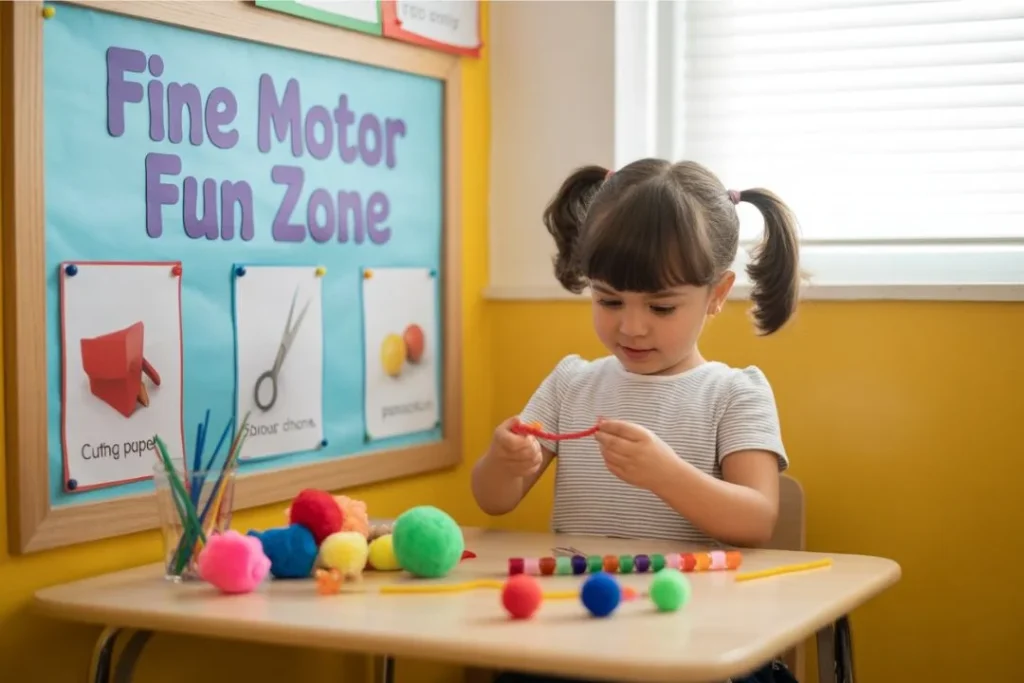
Of course, fine motor skills activities are very important for children’s development in schools. These activities prepare children for academic tasks and help in their physical and mental development. Schools should create various centers where children can participate in activities such as coloring, cutting with scissors, and playing with blocks.
Lack of hand-eye coordination
If children lack hand-eye coordination, they experience difficulty grasping or controlling objects, which affects their play and learning experiences.
(Conclusion)
Fine motor skills activities are essential for children’s mental, physical, and academic development at the age of 3 to 4. These activities build children’s self-confidence and give them the ability to perform everyday tasks. Parents and teachers should provide such activities to children so that they can lay the foundation for a strong and successful future.