(Introduction)
“Social skills IEP goals” are training and educational goals that are included in the Individualized Education Program (IEP) to improve the social skills of children receiving special education. These goals include children’s skills such as social interaction, recognizing and expressing emotions, respecting the feelings of others, cooperating, and increasing self-esteem.
In this article, we will learn what social skills IEP goals are, why they are important, how to write them so that they are specific, measurable, realistic, and time-bound, and will also provide many examples so that you can create the best goals according to the needs of your student or child.
Basic information about IEP and social skills
- An Individualized Education Program (IEP) is a plan created for students with special needs, where their academic and social needs are determined and specific supports, resources, and goals are set.
- The IEP team includes the student, parents, special education teacher, general education teacher, counselors, and other support staff.
What are Social Skills?
“Social skills” refers to the abilities that help an individual interact effectively, positively, and appropriately with others, such as:
- Starting and maintaining conversations
- Listening to others and responding appropriately
- Collaborating and sharing with others
- Recognizing and expressing emotions
- Understanding nonverbal cues such as facial expressions, body language, tone, and distance
- Solving problems, resolving differences
The Importance of Social Skills Goals in IEP
- Inclusion: This enables children to participate in regular classes, group activities, and social interactions.
- Academic achievement: Often academic tasks depend not only on academic skills but also on social skills — such as group projects, class discussions, teamwork, etc.
- Emotional well-being and self-esteem: When children can communicate effectively with others, understand and stand up for themselves, their self-esteem increases and emotional stress decreases.
- Long-term benefits: These skills come in handy throughout life — in jobs, friendships, relationships, everyday interactions.
How to Write Social Skills IEP Goals and Tips
Basic principles for improving goals (SMART principles)
It is important that social skills IEP goals are SMART:
- Specific: Be clear about which behavior or skill is to be improved, and in what context.
- Measurable: Progress can be measured — e.g., percentage, number, times, time, ratio, etc.
- Achievable: Be appropriate to the child’s current level and resources.
- Relevant: Be relevant to the student’s needs and daily life.
- Time-bound: Within a specific period of time. For example, six months, a school year, or a semester, etc.
Determining Current Levels of Performance
- Before writing goals, it is important to know where the student is currently in social skills.
- Use observations, teacher and parent feedback, social skill writing scales, communication or behavior history, etc.
- Write a detailed description of current skills and challenges.
Add target context
- Classroom, group activity, recess, playtime, home, community or social gathering spaces.
- Explain where the goals will be implemented, how, and what type of support will be provided (e.g. visual support, social stories, modeling, role play, etc.)
Monitoring and evaluation
- Develop a method for monitoring the achievement of goals: observation, data collection, teacher reports, video recordings, student self-assessment, etc.
- Create benchmarks or sub-goals to track progress step by step.
Examples of Good Social Skills IEP Goals
Below are several examples that you can modify to suit your student’s needs. These are great examples of “social skills IEP goals”:
Examples
Starting and maintaining a conversation
“By the end of the school year, students will initiate dialogue in small group activities with at least one peer per day and will take at least five turns, with appropriate language and appropriate eye contact, on 80% of occasions.”
Identifying and expressing emotions
“Within six months, the student will identify three different emotions (such as happiness, sadness, anger) from visual examples and express them using appropriate language on at least two occasions in everyday situations, at least 75% of the time.”
Understanding nonverbal cues
“By semester end, the student will recognize and respond to a variety of facial expressions and body language (e.g., nodding, frowning, smiling), with an appropriate response on three out of four occasions.”
Sharing and collaborating
“By the end of the school year, the student will collaborate socially in group projects or games, sharing content with others without constant prompting, on three out of four occasions.”
Conflict Resolution
“Within three months, the student will use ‘I’ statements during conflict (e.g., ‘I didn’t like it when…’) and will listen to others, on at least 80% of the occasions, in at least two different conflicts.”
Making and maintaining friendships
“By the end of the academic year, the student will have initiated at least two regular friendships or will have recess/lunch/group activities with them, once a week, demonstrating consistency on more than five occasions.”
Accepting unexpected changes
“By next semester, the student will encounter unexpected changes in the class routine or daily routine and will respond calmly rather than impulsively with naïve support (teacher prompts) or visual support on at least two out of three occasions.”
Maintaining appropriate physical distance (personal space)
“Within six months, the student will maintain appropriate physical distance with peers or classmates on five out of seven occasions, without repeated intervention from an adult, in a variety of social situations.”
Writing Social Skills IEP Goals — Detailed Step-by-Step Guide
This section will explain how you can write the best social skills IEP goals yourself, what questions you should ask, and what kind of language to use.
Analysis of the student’s current level
- In what situations does the student experience social problems? (e.g. group work, sports, class discussions)
- What methods have worked well? Which have not?
- Get feedback from parents, teachers, and students.
Determine which social skill is most important.
- Sometimes a big goal is too difficult — it’s better to focus on a few key skills (e.g., emotional expression, collaboration, and conversation initiation).
- Study where the student needs it most: class, friendships, home, or community.
Draft goals — should be SMART
- Specific: e.g. “starting a conversation”, “identifying emotions”, “making friends”
- Measurable: percentage, number, times, prompts, accuracy
- Achievable: according to the student’s ability
- Relevant: relevance to everyday life and the academic environment
- Time-bound: e.g. “in six months”, “by the end of the semester”, “by the end of the year”
Create sub-goals (benchmarks) or steps
- For example, if the goal is to maintain a conversation, then the first stage is two dialogues, then three, then five exchanges.
- If the goal is to identify emotions, then first pictorial examples, then character interactions, then real-life situations.
Add support and interventions
- Social stories
- Role play
- Modeling (teacher or peer modeling)
- Visual supports (cue cards)
- Group activities
Review and monitoring plan
- Use weekly or monthly data
- Observations, teacher and parent reports, student self-report
- Change intervention or approach if goals are not being met
A complete IEP social skills goal plan with detailed examples
Here is an example of a complete IEP plan for a hypothetical student, “Ali,” that includes social skills IEP goals. You can modify it to suit your use.
- Name: divrgt
- Age: Approximately 9 years
- Special Need: Mild difficulties with communication and social interaction, including initiating conversations, understanding other children’s emotions, and cooperating in group work.
- Current Level:
- divrgt does not often initiate conversations with friends, usually needs help from a teacher or parent.
- Emotional expression is limited — he is less able to express his sadness or anger verbally, mostly showing silence or anger.
- In group activities, he is hesitant to share content or take turns.
- Has poor understanding of nonverbal cues such as facial expressions, body language, etc.
Summary and Recommendations
- Social skills IEP goals are crucial for children’s social development so that they can better participate in education, build relationships, express emotions, and gain self-confidence.
- Better goals are those that are SMART, relevant to current levels, and applicable in real-life contexts.
- The partnership of the education team, teachers, parents, and students is essential.
- The participation of the special education team, teachers, parents, and students is essential.
- Goals should be continuously improved through monitoring and evaluation.
8 Major and Detailed Benefits (Benefits) of “Social Skills IEP Goals”
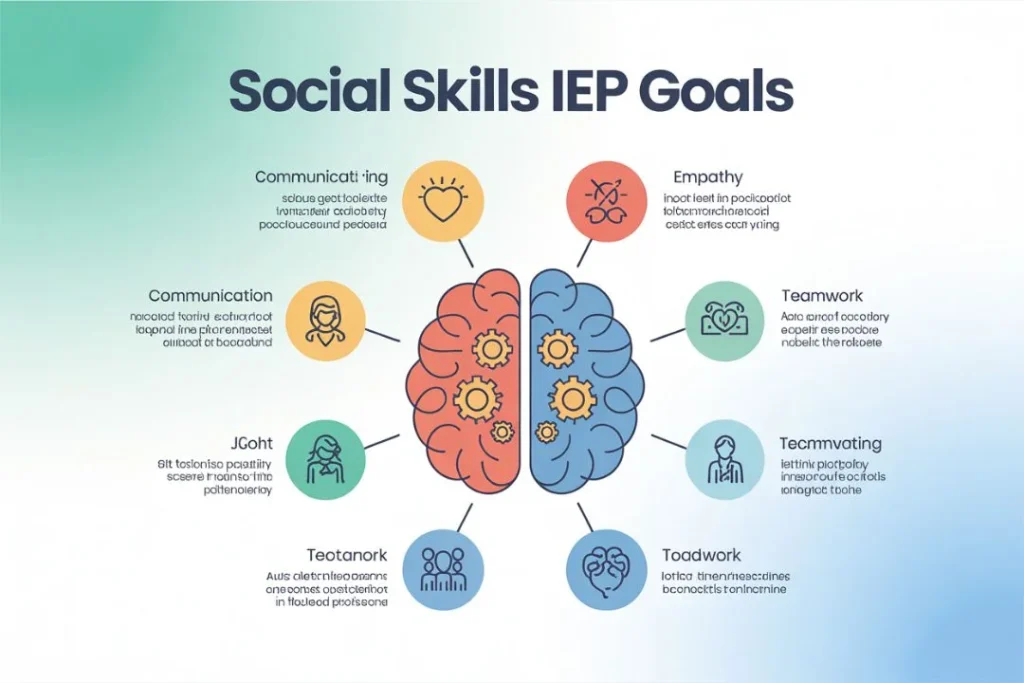
Great increase in students’ social self-confidence
When children are given clear, understandable, and structured social goals, they learn how to communicate socially, how to relate to others, and how to present themselves effectively. Over time, such students become more confident in their surroundings, experiencing less shyness, nervousness, or social anxiety.Their self-confidence grows, which is the foundation of all academic, social, and emotional development.
Better inclusion in group and classroom environments
- Often, special needs students are unable to integrate well into the general classroom because their social skills are weak.
IEP social goals specifically enable them to: - Work effectively on group projects
- Build relationships with peers
- Become part of a team rather than stand out
- All of these factors make children socially acceptable and protect them from loneliness.
Improved skills in making and maintaining friendships
Many special needs children want to be friends with others, but they don’t know how to start a conversation, or how to maintain a relationship.
Social skills IEP goals teach them the specific behaviors and interactions that are necessary for friendship, such as:
- Saluting
- Listening
- Playing together
- Resolving conflicts peacefully
- These skills are useful not only in school but throughout life.
8 Disadvantages (Disadvantages) — Social Skills IEP Goals
- It takes longer to achieve goals.
- There is a lack of specialists for specialized help.
- There may be additional financial burdens.
- Goals may not be the same because each child’s needs are different.
- Some children are afraid to participate in social activities.
- Constant monitoring and evaluation are required.
- Problems arise when there is no full support from home or the community.
- Children and parents may be frustrated when there is no progress.
8 FAQs (Frequently Asked Questions) — Social Skills IEP Goals
What are social skills IEP goals?
Social skills IEP goals are specific goals that are included in a child’s Individualized Education Program to improve their social skills. These goals are designed to develop skills such as children’s ability to communicate, understand the feelings of others, make friends, and work well in groups. The goal is to help children develop a positive and effective socialTo enable them to lead a social life, so that they can succeed not only in academics but also in their personal and professional lives. These goals are tailored to each child’s individual needs and abilities to achieve the best results.
When are these goals initiated?
Social skills IEP goals are usually initiated when a child has difficulty communicating, forming relationships, or interacting socially with others. These problems are often seen when a child is unable to connect with others in class or on the playground, has difficulty communicating, or has trouble understanding social cues.In this situation, teachers, parents, and specialists work together to assess the child’s needs and develop an individualized education plan, which includes clear goals for developing social skills. These goals are tailored to the child’s age, educational level, and social needs so that he or she can have a better social life.
Are the goals the same for every child?
No, each child’s social skills needs and development are different, so social skills IEP goals are also unique and specific to each child. Goals are created keeping in mind each child’s experiences, abilities, and weaknesses so that they can easily implement them and be successful.For example, some children only need practice in speaking, while others need training in understanding emotions and expressing their feelings. Therefore, goals are set for each child that will help them in their personal development and success.
How many goals is it best to set?
The number of social skills IEP goals is determined by the child’s needs and abilities, but it is generally considered appropriate to set 2 to 5 goals. Too many goals can be overwhelming and distressing for the child, while too few goals can limit the development process.An appropriate number of goals provides a clear direction for the child and also makes it easier for teachers and parents to track the child’s progress effectively. In addition, it is important to keep the goals measurable and realistic so that it is easy for the child to improve on them.
How is a child’s development assessed?
Social skills are a continuous and systematic process of assessing a child’s progress toward meeting IEP goals. Teachers and parents observe a child’s communication, behavior, and relationships with others in everyday activities. They note how often and to what extent the child is demonstrating social skills, such as how much effort the child is making to communicate, how they are interacting with friends, and how they are responding emotionally.Sometimes, specific tests or worksheets are used for this assessment to provide a clear picture of progress. Based on this information, the IEP team decides whether to change goals or provide additional support.
How can families help a child develop social skills?
Family members play an important role in improving children’s social skills. First, parents and other family members should talk openly with the child, listen to him, and encourage him to express himself easily. Provide an environment at home where the child can express his opinions and feelings. Parents should encourage children to make friends,Include them in social events or sports, and teach children to understand the feelings of others. Parents should understand the goals included in the IEP and work on them at home to ensure continuity in the child’s development. In addition, parents should stay in touch with teachers about their child’s progress.
Do these goals only apply to school?
No, social skills IEP goals are aimed at the overall social development of the child, so these goals are not limited to the school environment but also support at home, on the playground, and in social settings. The child is taught how to communicate with others in different settings, build relationships,, and solve problems. Collaboration between school and home is very important so that the child’s social skills are developed everywhere and he can live a happy and fulfilling life.
What should be done if children are unable to achieve goals?
If a child is having difficulty achieving social skills IEP goals or progress is slow, the IEP team should meet again immediately to review the situation. Goals should be readjusted to the child’s current abilities and additional support should be provided, such as specialized therapy,Additional coaching, or different teaching strategies. Parents and teachers should praise and encourage the child’s small successes to restore the child’s confidence. Sometimes the child needs more time and patience, so these difficulties can be overcome with consistent and positive support.
(Conclusion)
Social skills IEP goals are a stepping stone to children’s success and development in life. Through these individualized educational goals, children not only improve their communication and relationships, but also develop their self-esteem and emotional understanding. Social skills goals in a special education plan are a child’s personalityThey provide the foundation for building a strong foundation for future success. Therefore, it is important that parents, teachers, and experts work together to set effective and specific goals for children’s social development so that they can live a happy and independent life.